I've spent the day learning about how the original Flash Duel player track came to be instead, on the Flash Duel forums. The site seems to be down at the moment, I'd have to recheck the link to see if it works later.
Showing posts with label design diary. Show all posts
Showing posts with label design diary. Show all posts
Monday, August 27, 2012

Monday, August 20, 2012
Design Diary Monday: From Pirates to Bar Fights in Less Than Seven Days
Before I move on from Pirates to Bar Fights, let me finish explaining how the revised pirates duel work. The trinity (Strike, Parry, Focus) forms the core of the system. Because focus is not an attack but a bonus to another action, I added another card that'd benefit directly from focus and adds a little randomness to the game, hence Unload. Since Strike at this point would have advantage over two cards (Focus and Unload), I've added one final card that's sort of a bigger counter to Strike - and that's how Brutalize came about.
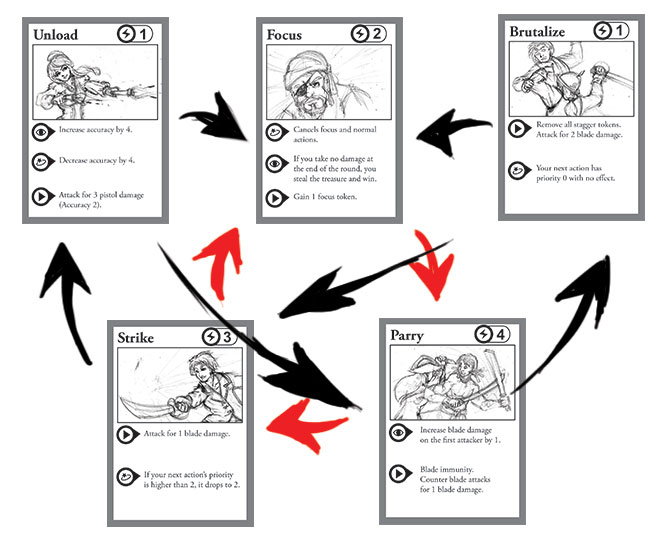
Staggering as a status was added to the game to resolve some of the hard counters between cards. Focus was added to shift the attributes of the cards so the counters would work differently from one turn to the next. This is all nice and well, except... well, it isn't. The web of cause and effect gets fairly difficult to explain, and ultimately the complexity counteracts the attempt to reduce a sense of randomness to the card choice - between the focus buff and the stagger debuff, there's way too many combinations of resolutions for any normal player to keep track of.
And then there's the multiplayer version of this game, where you choose an attack and aim it at another player, then they still simultaneously resolve by order of priority... it's just chaos from that point on. Honestly, I would still like to run a small test with these rules just to see how chaotic the attack guessing game goes, but I never got a chance over last week, and I felt like the premise should stay, but I should stop trying to make the game so deterministic.
Let's introduce some chaos into the game.
I watched a rerun of Dead Man's Chest again over the weekend (is TNT just showing this movie every other week?), and the bar fight scene gave me an idea. Let's remove focus and brutalize and start fresh with a new trinity:

Now, let's change Unload into some form of liquor. "Unloading" now means smashing the bottle on someone's head. We'll also untangle all the priorities and simultaneous resolution so besides parrying to counter, all the actions are played one card at a time. We've untangled the game completely and now we're just playing a basic "take that" game (every turn a player toss a damage dealing card, some cards are there to block attacks, etc).
But the liquor part of the game can get interesting. Suppose there's a running tab on the amount of liquor smashed and consumed, wouldn't it make sense that the guys who lose the fight would have to pay the tab somehow? What if the liquor can be consumed to strengthen strikes? We arrive at the following rules:
Staggering as a status was added to the game to resolve some of the hard counters between cards. Focus was added to shift the attributes of the cards so the counters would work differently from one turn to the next. This is all nice and well, except... well, it isn't. The web of cause and effect gets fairly difficult to explain, and ultimately the complexity counteracts the attempt to reduce a sense of randomness to the card choice - between the focus buff and the stagger debuff, there's way too many combinations of resolutions for any normal player to keep track of.
And then there's the multiplayer version of this game, where you choose an attack and aim it at another player, then they still simultaneously resolve by order of priority... it's just chaos from that point on. Honestly, I would still like to run a small test with these rules just to see how chaotic the attack guessing game goes, but I never got a chance over last week, and I felt like the premise should stay, but I should stop trying to make the game so deterministic.
Let's introduce some chaos into the game.
I watched a rerun of Dead Man's Chest again over the weekend (is TNT just showing this movie every other week?), and the bar fight scene gave me an idea. Let's remove focus and brutalize and start fresh with a new trinity:

Now, let's change Unload into some form of liquor. "Unloading" now means smashing the bottle on someone's head. We'll also untangle all the priorities and simultaneous resolution so besides parrying to counter, all the actions are played one card at a time. We've untangled the game completely and now we're just playing a basic "take that" game (every turn a player toss a damage dealing card, some cards are there to block attacks, etc).
But the liquor part of the game can get interesting. Suppose there's a running tab on the amount of liquor smashed and consumed, wouldn't it make sense that the guys who lose the fight would have to pay the tab somehow? What if the liquor can be consumed to strengthen strikes? We arrive at the following rules:
- There are three main types of cards, punch, block, and liquor.
- Liquor can be consumed or smashed onto other people.
- if you drink it, you play it in front of you and the cost adds to your personal tab, but your punches becomes stronger and you draw more cards based on the cost of the liquor, gaining a significant advantage.
- if you smash it, you use the card as an attack on another player. The discarded bottle adds to a growing pool of damage tab that someone will have to pay.
- Punch card deals direct damage. Every drink you have makes your punch stronger.
- Blocks reduce or deflect damage, and are played as reactions to other players' attacks.
- If a player sustains X damage, he or she is knocked out and must pay for everything in the damage tab.
- A player can also play a card to try and walk out of the bar fight. If he or she is attacked that turn, that player can't block and the attempt to walk out also fails. If the player does walk out of a fight:
- if multiple players walk out on the same turn, they share whatever has to be paid off that turn.
- if there's still players left, add up the personal tabs of the players leaving and each player pays an even share.
- otherwise, you'll have to pay an even share for the damages as well.
- When there's only unconscious players left in the bar, all unconscious players must pay an even share of everything that's not paid for.
- To give the player who is most invested in the fight an advantage, whoever is the most drunk (with the biggest personal tab) can go first.
If the numbers work out right, there should be an escalation of cost built into the game that'd make it interesting for players to decide when to stay and when to quit. There's a much bigger factor of randomness, but I think the new design is "light" enough that more randomness might actually make the game better.
And now, back to assigning numbers. I hate this part.
Monday, August 13, 2012
Design Diary Monday: Revising Rock Paper Scissors Since 2012
Human creativity is weird. If you force yourself to think about new solutions to a problem sometimes all you can get are dumb fixes... but if you step away from the problem for days or even weeks, sometimes the solution would hit you on the head like an anvil out of nowhere. After so many previous failures, I'm not so ready to call this the design that solved all the problems, but at least I feel like it's getting somewhere again.
In other news, I've learned that tags can do something other than serve the mysterious SEO gods. I've added a new tag to keep track of all the posted related to this particular game's design progress:
To more or less reboot the design process, I've decided to take out treasure points, targets of opportunity, and all the other mumbo jumbo that's related to scoring more points... I've reduced the game back down to its basics, a rock-paper-scissors game. I've also mentally sort through all the feedback I've gotten from previous play tests and incorporated a few suggestions:
- Sometimes, randomness is not such a bad thing. While it reduces the deterministic aspect of the game, it creates situations with calculated risk that'd at least give a bad choice some chance to make a comeback.
- Trying to resolve combat from a single card choice was probably a disastrous idea. Without a series of shifting parameters and each card choice giving the same probability to win or lose, the choice becomes completely random even if the decisions are weighted differently - as long as there's exactly one hard counter to each possible choice, players are still forced to consider each choice evenly.
- And building on the previous point, there really needs to be some way to predict player behavior in order for players to decide on an action instead of randomly picking one.
So I've added an additional mechanic to the basic "deal X damage" formula: modifiers that'd affect actions in the next turn. And with that, here's the component dump of the latest pirates card game:

While still themed around pirates, the game is no longer about ship to ship combat with captain and crew - now we're down to fighting over treasures on an individual level. A simplified list of rules is as follows:
- Each player begins combat with 5 cards.
- Each player plays a card each round.
- Higher priority cards are resolved first. If multiple players have cards of the same priority, the player with higher initiative takes precedence.
- As a player's action is being resolved, grab the highest priority token that's not yet taken.
- If a condition is applied to a card's action, resolve them in the order they're listed on the card.
- If a player takes damage and that player's action card has not completely resolved, apply a stagger token to that player's action.
- If a focus token is available, consume it whether the card has a focus condition bonus or not.
- A player who takes 3 points of damage or more is knocked out.
Balancing are a-coming, so I'll discuss the cards and the justification for the rule changes in detail next week. In the mean time, here's an example game of how the game works in its current form:
(Oops, I've forgotten to put down stagger tokens completely. Oh well, the player who takes damage is usually staggered...)

Bottom player plays strike and gains initiative. Strike can stagger gun Unloads and make them miss. Strike also deals light damage.

However, strikes can be parried. Parrying deals damage to the aggressor to inflict stagger (and it does resolve, since stagger for strikes resolve after the normal action).

You can unload guns on a player that's standing around ready to parry for a 1 in 3 chance to deal 3 damage (in most circumstances, winning outright). Better yet, you can play focus to gain the focus buff. The buff makes the next gun attack 100% accurate.

However, since focus has lower priority, the bottom player gained initiative that round. In the next round, the players have the same priority, but since the bottom player maintains initiative, the bottom player brutally finishes the top player off by dealing 2 damage. Mmm, this is not exactly what I want to happen... Yup, changes are a-coming.
Next week: Justify your game.
Monday, August 6, 2012
(Belated) Design Diary Monday: I Am Not a Wizard With Spreadsheets
One of the many weaknesses I have with game balancing is I have an extremely poor background in statistics, and apparently statistics is all the rage as far as balancing numbers are concerned.
A few weeks ago, a certain reddit topic brought me to the use of hypergeometric distributions. My current work in progress idea surrounding deception will make heavy use of the concept of "BS" style card game and some type of melding card game.
I've started with this google spreadsheet. The only relevant table is the third one at the bottom that shows the probability of the player having N or more cards after drawing X cards from the deck. The one published above uses a standard deck of playing cards, and calculates the probability of having N or more cards of the same suit.
If each project type in my game idea corresponds to a single card suit and the values doesn't matter, then the distribution would show me how many cards a player might need to complete a project on his or her own, using materials (cards) of the appropriate suit.
Just to throw it out there, a 5 card project size seems to be a reasonable number. The distribution tells me that there's a 50% chance I'd have 5 cards of the same suit... after drawing 18 cards? That can't be right.
The percentages are deceptive. The number tells me the percentage of all possible hand of 18 cards... but I've been starting with a hand of 5 cards and consciously made a decision to pursue a suit that I already have - often with 2 cards. Adjusting the starting numbers to a 47 card "deck" (since I've drawn 5 cards already) and 11 cards that'd yield me the same suit (since I already have 2 in my hand) yields a much more reasonable 50% to get 3 more cards of the same suit at the 11th draw... until I realize that I've already drawn 5 cards in this case so technically I'd get the 50/50 at the 16th card. Replaying a few hands with a real deck of card confirms this - getting that "flush" is actually pretty darn hard.
Interestingly, there's a 62% of having 5 cards or more of the same suit in the beginning of a 4 player game, if each player draws 5 cards to start with. If the game allows trading, the chance of getting those 5 cards would be significantly easier.
These numbers, once I mess around with it some more, can tell me a lot - it sets boundaries for quantities that are within reason, and with these guidelines I can come up with a card mix for my initial test. It's probably a lot harder to look for the fun in those numbers, but I firmly believe that's where the number crunching part of game design stops and the art part begins.
Tomorrow (well, later today): the promised initial numbers for the deception game. This design is going overtime!
A few weeks ago, a certain reddit topic brought me to the use of hypergeometric distributions. My current work in progress idea surrounding deception will make heavy use of the concept of "BS" style card game and some type of melding card game.
I've started with this google spreadsheet. The only relevant table is the third one at the bottom that shows the probability of the player having N or more cards after drawing X cards from the deck. The one published above uses a standard deck of playing cards, and calculates the probability of having N or more cards of the same suit.
If each project type in my game idea corresponds to a single card suit and the values doesn't matter, then the distribution would show me how many cards a player might need to complete a project on his or her own, using materials (cards) of the appropriate suit.
Just to throw it out there, a 5 card project size seems to be a reasonable number. The distribution tells me that there's a 50% chance I'd have 5 cards of the same suit... after drawing 18 cards? That can't be right.
The percentages are deceptive. The number tells me the percentage of all possible hand of 18 cards... but I've been starting with a hand of 5 cards and consciously made a decision to pursue a suit that I already have - often with 2 cards. Adjusting the starting numbers to a 47 card "deck" (since I've drawn 5 cards already) and 11 cards that'd yield me the same suit (since I already have 2 in my hand) yields a much more reasonable 50% to get 3 more cards of the same suit at the 11th draw... until I realize that I've already drawn 5 cards in this case so technically I'd get the 50/50 at the 16th card. Replaying a few hands with a real deck of card confirms this - getting that "flush" is actually pretty darn hard.
Interestingly, there's a 62% of having 5 cards or more of the same suit in the beginning of a 4 player game, if each player draws 5 cards to start with. If the game allows trading, the chance of getting those 5 cards would be significantly easier.
These numbers, once I mess around with it some more, can tell me a lot - it sets boundaries for quantities that are within reason, and with these guidelines I can come up with a card mix for my initial test. It's probably a lot harder to look for the fun in those numbers, but I firmly believe that's where the number crunching part of game design stops and the art part begins.
Tomorrow (well, later today): the promised initial numbers for the deception game. This design is going overtime!
Tuesday, July 31, 2012
(Belated) Design Diary Monday: Deception
Last Monday I began brainstorming ideas central to the Pirate movies, and after mulling over it for the rest of the week I've found the concept of deception to be the most intriguing. Deception was present, or it was intended to be present, in every stage of the pirates card game design, where part of the crew you set sail with are suppose to be hidden, but in practice what your enemy brought to a fight never seemed to matter as much as your own composition.


So I kept the idea of deception as the central mechanic and narrowed my focus. When it comes to deception, two types of games come to mind: hidden role games like Mafia or The Resistance, and hidden value games like Dead Man's Chest's very own Liar Dice (okay, the movie didn't invent the game, but it certainly brought it to most people's attention). Of the two, I've come up with an idea to work with hidden values: the art of running researches and the possible deception involved in securing funding while having honest breakthroughs versus lying through your teeth.
In the beginning, I've started the idea with two very basic concepts: research projects and research breakthroughs, which supports the projects. The projects are public knowledge: everyone knows you're working on a project and trying to complete it in time. The breakthroughs, however, are hidden by default: you may have materials strongly tied to the project (yellow), "wildcard" materials (green) that supports the project but not to the degree of the "pure" stuff, and fake materials (white) that are made up stuff to prop up your project's credibility. The deception surrounding your research's actual progress forms the core idea of the game.
Expanding on this core idea yield the following:
Let's say your research's real progress is the sum total of your relevant material's strength (let's just call breakthroughs "materials" for now). Strong materials gives you 2 points, related materials 1 point, while made up materials obviously 0. At some phase in the game, investors would come in and invest more funds based on the number of materials you have, not the actual progress of your research. In turn, you can pour those funds into acquiring more projects and getting actual breakthroughs. This sets up the incentive for players to risk putting down fake progress because it means they'd get themselves the real stuff faster. We still need a reward mechanism for busting other people's lies though:

Here is one possible implementation of the investigation mechanic. An opposing player must spend some of the grant money for a private investigation into some aspect of the research. The more you pay, the more through the investigation becomes. For example, a cheap investigation can only randomly expose whether one of the materials is completely fake; another one might reveal several pieces of info at once; the strongest would probably tally all the materials and wager the actual progress is below a certain level. Problem is, I don't feel like there's a good reward to a successful investigation that is thematically and mechanically sound. I suppose the one paying for the investigation might get money from a lawsuit, and maybe this model is ultimately the best one (since it is extremely simple), but the one that I'm going to try developing actually looks like this:

So I've added one more layer to a research project, that is when you have enough actual progress, you can open up those materials to sell a real product for money and reputation. Reputation becomes the game's real measure of victory, not money. It gives research projects a natural life cycle so there's no need to clog up the play space with projects where all progress are real, and I can balance the game to give honest players appropriate rewards. I can also set up a reward for investigations that thematically makes sense - reputation - where exposing other researcher's bad practices would earn you some reputation but falsified claims might actually give you a reputation penalty. That part of the diagram might be changed, to be honest, but I think I'd very likely keep the "release a product" part of the project life cycle - it completes the game in ways that the simple version simply cannot.
I have some other ideas such as having collaborating research partners (splitting funds and reputations), or special restrictions attached to specific projects, but the general idea is sound. The next phase of the project involves a bunch of heavy calculations to come up with an initial set of numbers attached to all the different components of the game. Math... I guess... I'll do that next week. Yup!
Monday, July 23, 2012
Design Diary Monday: Brainstorming Solutions
Alright, so starting from this week there's no more scripts for me to follow. I've arrived back at the point where I need to make changes to the game, and I'll be spending the time on these posts actually working out problems instead of reporting results from the past.
The first order of business is to try and see if the pirates card game, in any form, is salvageable. I had a chance to watch some of the Pirates of the Caribbean movies over the past few weeks, and I was reminded of the things I wanted to portray:
The first order of business is to try and see if the pirates card game, in any form, is salvageable. I had a chance to watch some of the Pirates of the Caribbean movies over the past few weeks, and I was reminded of the things I wanted to portray:
- Hunting for legendary treasure (Aztec gold, the compass, the heart, what have you)
- Deals and betrayals
- Satisfying broadsides making ships explode
I didn't think I was successful in getting any of those points across. I've never come up with a convincing way to make players go after specific pieces or types of treasure; none of the versions ever got to a stage where temporary alliances made sense. The closest I've gotten were the ship battles, back when there were dice rolling... getting a good cannon roll and making ships explode on the spot felt good, but that was all the way back to the first version of the game and I don't want the rules to ever get that complicated again.
Honestly, let's just pretend I have the Pirates of the Caribbean license for a moment and think about how I can get the back and forth wheelin' and dealin' between all the characters work as game mechanics. In Dead Man's Chest,
- Jack needed the Dead Man's Chest to avoid his fate of servitude
- Will needed the Compass from Jack to secure Elizabeth's Release
- Elizabeth acquired the Letter of Marques but needed the Compass in return
- Jack agreed to trade the compass for the chest...
...
Actually, this is clearly not as complicated as I remembered, is it? An easier way to describe the formula is,
- Player 1 is after item A
- Player 1 has B but for some reason cannot directly reach A
- Player 2 is after item C, and he can trade B for C
- Player 2 now has the option to get A so he can trade with Player 1 for B, or steal B from player 1, or negotiate with a player 3 directly for C instead...
Okay, the trading is getting Catan-ish. I can work with that. Ultimately, I think I'll need to introduce secret objectives to the game: for simplicity's sake, let's say each player needs to acquire some unique item that won't come up as a found treasure.
Secondly, there would be time limited opportunities that allows items to convert from one type to another. probably a set of cards that shows the item obtained with the item requirement in small print.
Thirdly, items randomly appear and the players have low influence on the items they can get their hands on. It sets up scenarios where two player can trade items that'd benefit each other. There needs to be justifiable reason for trade to make more sense instead of just killing or blowing up each other, which should be an option...
I guess this is how the game would proceed. Next week I can continue this work or try and fix the rock-paper-scissors combat!
Monday, July 16, 2012
Design Diary Monday: Stuck In a Rut
Well, we've caught up with the present with my current game's design process, but I suppose that may not necessarily be a good thing. There's several numeric problems with the design right now that can be eventually fixed, and several fundamental design issues that might prompt another design change or just outright abandonment of the project.
I wrote down the rules last week, in case anyone is looking for a reference:
Here is how the game is breaking down at the moment:
I wrote down the rules last week, in case anyone is looking for a reference:
Here is how the game is breaking down at the moment:
- It is optimal for each player to attack the target that appears on his or her turn instead of someone else's target. By default, if you secure your own target of opportunity on your turn and you're not being attacked, you're guaranteed to score those points; however, if you attack another player and fail, you lose all the cards you spend to attack and you get no treasure. Even if you win, you've only denied another player one turn's worth of points and as it turns out, in a game where the current point totals are blind, people tend to only track their own points and not worry so much about the points other people are getting, even if it means they'd lose in the long run.
- The problem is compounded when the loss from failure don't justify the cost of attacking players. Since there's no limit on the number of cards used to form ships and crews, players just kept dumping entire hands in order to secure his or her own target. Your hand increases by 1 each turn, without an upper limit, but whenever you lose, you lose everything and the hand size resets. Players become even more risk averse as the game goes on for that reason.
- The rock-paper-scissors mechanics don't work if a preference for a certain attack can't be established. There's an even number of pirate, sailor, and broadside cards in the game. You are severely disadvantaged without one of the three types of units, so you'd tend to see hands with all three unit types in every hand. In the end, knowing part of what the hand contains is useless, since all card types are probably present anyway. Throwing out random cards can score you as many victories as defeats, just like a normal game of rock paper scissors. The meta game is suppose to offset the risk-reward of the individual elements, but so far none of the designs worked toward that goal.
And now, back to the drawing board. I've been drawing blanks about this game's design lately, but hopefully I'd come up with something to talk about next week.
Monday, July 2, 2012
Design Diary Monday: Papercraft and Player Boards and Ships, Oh My!
When I thought I've designed my card game to my corner, I've considered my options and I've decided to make some changes, radical changes. So many changes that only things remained were the two principles of rock-paper-scissors ship battle and the use of the pirate dice. Well, that actually fixed a lot of things in place. So how different could the new iteration look? Well...

Behold, CUBES!
Instead of ships being represented by ship cards, the players actually have paper ships... the pirate and cannon crew cards became pirate and cannon cubes. Treasure from the locations? Cubes. The only thing that remained cards were the locations and the single use voodoo cards. Instead of forming ship and crew with cards, you loaded cubes into your ship... when attacking, you added cubes to your ships. Ship to ship combat still revolved around the strategy cards, but the cubes determine the dice numbers when cannon or melee rolls were made.
The changes looked good in theory. It radically redefined what information was hidden and what was known since you can't put treasure or crew cards face down. Treasure hunting also became very eurogameish when players basically look for the best way to obtain the most treasure in the current round. Ship to ship combat was available to throw players seriously off-balance when necessary.
Unfortunately, the radical change of appearance was accompanied by rule changes that broke the system: for example,

Behold, CUBES!
Instead of ships being represented by ship cards, the players actually have paper ships... the pirate and cannon crew cards became pirate and cannon cubes. Treasure from the locations? Cubes. The only thing that remained cards were the locations and the single use voodoo cards. Instead of forming ship and crew with cards, you loaded cubes into your ship... when attacking, you added cubes to your ships. Ship to ship combat still revolved around the strategy cards, but the cubes determine the dice numbers when cannon or melee rolls were made.
The changes looked good in theory. It radically redefined what information was hidden and what was known since you can't put treasure or crew cards face down. Treasure hunting also became very eurogameish when players basically look for the best way to obtain the most treasure in the current round. Ship to ship combat was available to throw players seriously off-balance when necessary.
Unfortunately, the radical change of appearance was accompanied by rule changes that broke the system: for example,
- A new rule was added to encourage risk taking, where if you decided to haul your treasures in, you'd lose your shot at the rest of the treasures on the table. It forced every player to stay at sea for as long as possible, and created some truly bizarre scenarios where every single ship from every player destroyed each other completely, ending a turn with zero treasure taken.
- The sea combat rules were patched to a ridiculous degree to accommodate for the possibility of ships attacking without cannons, exasperated by loopholes around the evade->broadside counter. If evading cannons meant starting a new turn without changing the state of the game, a player with a ship without cannons but with superior pirate count could simply evade to force the game into an infinite loop. If evading cannons grant the player without cannons a chance to pursue (which broadside normally beats), then it weakens the usefulness of broadsiding. This might be hard to explain without the rest of the rules, but imagine if paper beating rock only resulted in a draw... or paper can transform to rock when faced with scissors. Any patchwork solution that me and my friend could come up with ended up short.
among other things. As a result, I believed the noble experiment of radically changing the game to a board game failed... but changing the game's format gave me a lot of insight about the workings of the core mechanics, namely that the pirate/cannon strength numbers play an extremely important role in combat and should not be arbitrarily quantized; that the treasures were not interesting enough to form a eurogame system around; that forcing players to take too much risk for removed real choices. Those were all lessons that I took to heart as I humbly remove all the cubes from the game and transform everything back into card game format.
Next week: heavy consolidation.
Monday, June 25, 2012
Design Diary Monday: Let the Pirating Begin
After the design process for Summoner went badly, I wanted another shot at designing a Magic like game. I dropped the "design a card" mechanic and returned to cards with fixed powers and abilities. Then I introduced two new X-factors: the rock paper scissors combat that is broadside/evade/pursue, and pirates dice with special dice faces. By the time of this writing, I've thrown away and reused the majority of the card sleeves for later iterations of the game, so here's just a tiny sample of how the game used to look like:

The players were pirates trying to control as much treasure (yellow cards) as possible by the end of the game. Each player controlled a hand of pirate crew (white cards) and several pirate ships (blue cards). In the beginning of each round, a set number of treasure was added to each location (green cards) on the board. Players took turns attacking locations by forming a ship and crew where the total rum use of the crew must not exceed the rum supply of the ship (the circled numbers). A ship loaded with treasure was considered sailing at sea and was open to other player's attacks.
Combat mainly revolved around the broadside/evade/pursue strategy cards. Each player chose a strategy and revealed them at the same time, and the general resolution was broadside beat pursue, pursue beat evade, evade beat broadside. Several strategy combinations would require tossing dice equal to the strength numbers (numbers next to cannons and cutlass icons) to resolve, such as a broadside exchange. Almost all cards had special abilities attached: the crew, the ships, and even some treasures could modify some part of the game. Putting the ship and crew together made the game interesting, but ultimately it also made the game too difficult to track.
To be fair, this version of the game was great for two players, with reasonable downtime and a manageable amount of information to track. The game got too complex once it scaled up to three or more players, though, and I personally lost track of my crew abilities while testing a four player game. When that happened, I was convinced that some dramatic pruning of game mechanics was necessary to scale the game up to my goal of six total players.
In fact, the next version had so much change that it felt like the game took a wrecking ball in its face. Next week: what happened? Paper ships and cubes?

The players were pirates trying to control as much treasure (yellow cards) as possible by the end of the game. Each player controlled a hand of pirate crew (white cards) and several pirate ships (blue cards). In the beginning of each round, a set number of treasure was added to each location (green cards) on the board. Players took turns attacking locations by forming a ship and crew where the total rum use of the crew must not exceed the rum supply of the ship (the circled numbers). A ship loaded with treasure was considered sailing at sea and was open to other player's attacks.
Combat mainly revolved around the broadside/evade/pursue strategy cards. Each player chose a strategy and revealed them at the same time, and the general resolution was broadside beat pursue, pursue beat evade, evade beat broadside. Several strategy combinations would require tossing dice equal to the strength numbers (numbers next to cannons and cutlass icons) to resolve, such as a broadside exchange. Almost all cards had special abilities attached: the crew, the ships, and even some treasures could modify some part of the game. Putting the ship and crew together made the game interesting, but ultimately it also made the game too difficult to track.
To be fair, this version of the game was great for two players, with reasonable downtime and a manageable amount of information to track. The game got too complex once it scaled up to three or more players, though, and I personally lost track of my crew abilities while testing a four player game. When that happened, I was convinced that some dramatic pruning of game mechanics was necessary to scale the game up to my goal of six total players.
In fact, the next version had so much change that it felt like the game took a wrecking ball in its face. Next week: what happened? Paper ships and cubes?
Monday, June 18, 2012
Design Report Mondays: In The Beginning
As an experiment, I'm going to try updating each weekday for as long as I can. Each day of the week is going to be based on a different topic, and design reports record the progress of my current card/board game concept. However, since I didn't start doing this from the very beginning, I'll be playing catch up for a few weeks...
Summoner is my first attempt to create card games again after an extremely long hiatus. Its goal is to be a Magic clone; specifically, a Magic clone that retains the deck building aspect of the game without the necessity for an ever expanding list of cards. The game broke down things like power, toughness, and keywords into separate cards, and formed rules around the combination of cards into making creatures and spells.
It was also the first and last time I made a huge effort to produce good looking prototypes. Here was the last iteration of the prototype deck before I gave up on the idea:

The basic premise was to convert mana into element cards. When an offensive and a defensive element was combined, it formed a golem with the attributes determined by the strength of the elements. Most spells worked like Fireball where you substitute elements to generate a specific effect of variable strength. It felt interesting in theory, but the implementation fell apart quickly.
For one thing, the cards were drawn instead of drafted, and despite attempts to make elements with lower strength "faster", bigger numbers were always better. Eventually, I wrote in so many special rules that the game started to become as cramped and as unintuitive as Magic became. For those reasons, I shelved the project, but the idea of forming a group of custom creatures to attack and defend objectives stayed, and it was the seed that was replanted into the idea that I'm still working to this very day.
Next week: pirates!
Summoner is my first attempt to create card games again after an extremely long hiatus. Its goal is to be a Magic clone; specifically, a Magic clone that retains the deck building aspect of the game without the necessity for an ever expanding list of cards. The game broke down things like power, toughness, and keywords into separate cards, and formed rules around the combination of cards into making creatures and spells.
It was also the first and last time I made a huge effort to produce good looking prototypes. Here was the last iteration of the prototype deck before I gave up on the idea:

The basic premise was to convert mana into element cards. When an offensive and a defensive element was combined, it formed a golem with the attributes determined by the strength of the elements. Most spells worked like Fireball where you substitute elements to generate a specific effect of variable strength. It felt interesting in theory, but the implementation fell apart quickly.
For one thing, the cards were drawn instead of drafted, and despite attempts to make elements with lower strength "faster", bigger numbers were always better. Eventually, I wrote in so many special rules that the game started to become as cramped and as unintuitive as Magic became. For those reasons, I shelved the project, but the idea of forming a group of custom creatures to attack and defend objectives stayed, and it was the seed that was replanted into the idea that I'm still working to this very day.
Next week: pirates!
Subscribe to:
Posts (Atom)

-
 So I've been a proud owner of an HTC Vive for about two months now, and I've had my share of demos to friends and family alike. W...
 -
 This is the newest strip from The Escapist's Critical Miss . Satire be damned, when it comes to cool concepts you just can't go wron...